Textile Industry Evolution: The Impact of New Technology
The roots of the textile industry evolution in India track back to the Indus Valley Civilisation. Fast forward to 2026, and textiles now contribute nearly one-third of India’s exports and around 5% of its overall GDP. Radhey Krishna Cotweaving has seen this transformation first-hand over the last decade of manufacturing premium sustainable fabrics.
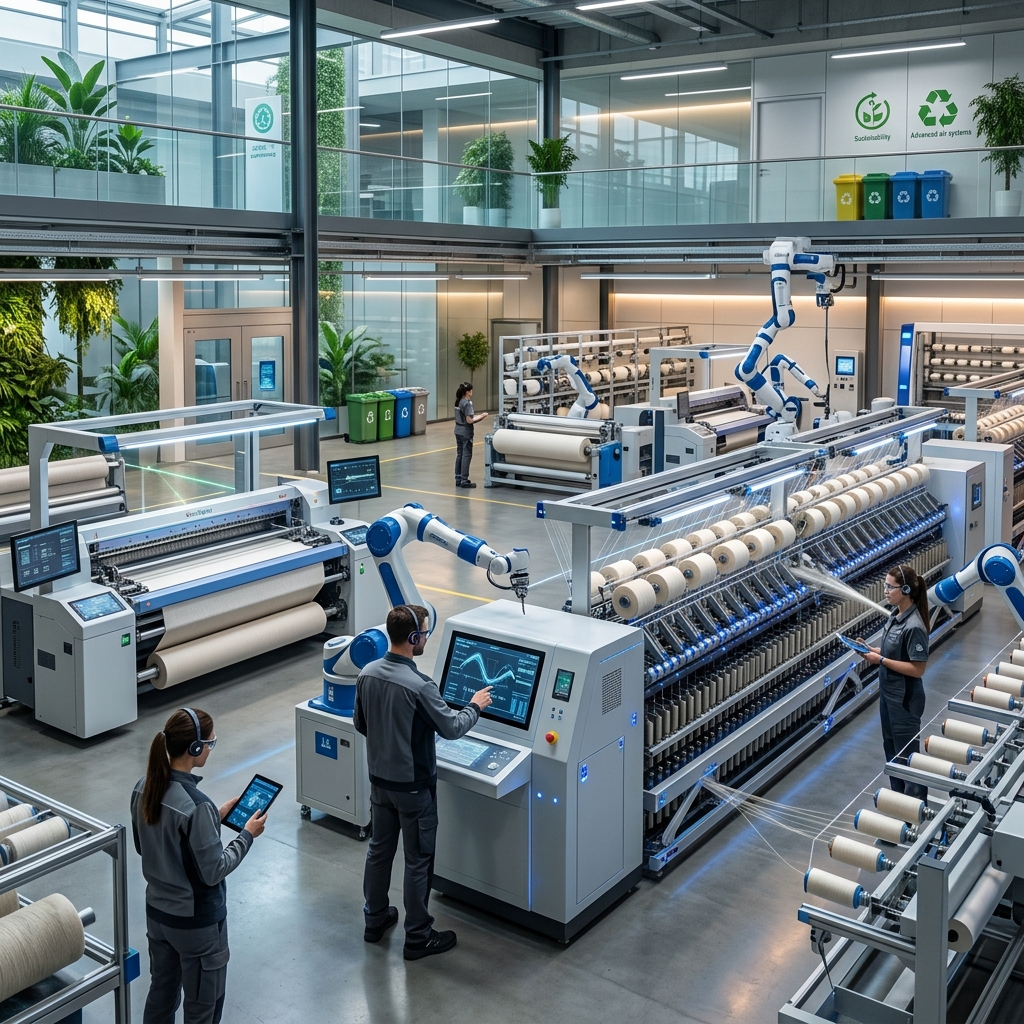
This massive growth relies heavily on technological advancement, automation, and digital integration. Modern textile mills no longer depend solely on manual labor. Instead, they leverage smarter spinning machinery, AI-driven quality control, and sustainable energy grids.
How Has Textile Technology Evolved Over Time?
Textile technology has evolved from manual handlooms in the pre-industrial era to fully automated, AI-driven smart mills in 2026. The integration of IoT sensors, robotics, and renewable energy has shifted the focus from labor-intensive production to high-speed, precision manufacturing that prioritizes sustainability and zero-waste systems.
Before the industrial revolution, textile production was incredibly slow. Workers spun fibers into yarn and wove fabric entirely by hand. However, the introduction of the power loom and modern spinning frames changed the trajectory of manufacturing permanently. Over the last two centuries, this sector has moved from rudimentary handlooms to high-tech facilities. Today, heritage craftsmanship intersects seamlessly with cutting-edge engineering.
Traditional vs. Modern Textile Manufacturing
| Feature | Traditional Manufacturing | Modern Manufacturing (2026) |
|---|---|---|
| Production Speed | Low and labor-intensive | High-speed automated continuous processing |
| Quality Control | Manual visual inspection | AI-driven optical scanning and fault detection |
| Energy Source | Coal and non-renewable grid | 100% renewable solar and wind energy |
| Data Tracking | Manual ledgers and offline logs | Real-time IoT sensors and RFID tracking |
| Customization | Slow setup and limited patterns | Rapid digital printing and 3D modeling |
How Is Automation Transforming Textile Production?
Automation transforms textile production by replacing manual ring-spinning with compact spinning technologies. This increases production speed by up to 40%, eliminates human error, and allows mills to process both natural and man-made fibers with extreme precision, resulting in stronger and more consistent yarn at scale.
In earlier decades, yarn-making demanded hundreds of workers monitoring individual spindles. Today, automated compact spinning technologies dominate the factory floor. These systems handle the delicate drafting process automatically, creating stronger and more uniform yarns.
At Radhey Krishna Cotweaving, this automation translates directly into reliability. When a fashion brand orders 10,000 meters of cotton canvas, automated looms ensure the first meter is exactly identical to the last.
What Role Do Smart Machinery and Silver Handling Play?
Smart machinery and automated silver handling systems reduce production downtime by 15-20%. Equipment from manufacturers like Rieter and LMW use predictive maintenance sensors to prevent mechanical failures, ensuring a continuous, smooth production line for high-volume textile manufacturing.
The integration of modern machinery has revolutionized spinning mills. Leading equipment manufacturers have introduced advanced machines equipped with sensors that actively monitor their own health.
Innovations in spinning cans and sliver handling systems drastically improve efficiency. Modern mills use fully compatible sliver cans that communicate their fill levels wirelessly, eliminating bottlenecks and mechanical jams on the factory floor.
How Are 3D and Digital Printing Used in Textiles?
Digital printing in textiles applies intricate patterns directly onto fabric using specialized inkjet technology, reducing water waste by up to 90% compared to traditional dyeing. Meanwhile, 3D printing is emerging for custom apparel components, allowing brands to manufacture complex, personalized designs on demand.
Unlike traditional rotary screen printing, digital printing requires no physical screens or massive setup times. It allows complex motifs to be applied with speed and incredible precision. This flexibility helps brands offer customized, on-demand collections without holding massive amounts of pre-printed inventory.
What Does Digital Transformation Look Like in Modern Mills?
Digital transformation in modern textile mills involves integrating AI, data analytics, and IoT sensors across the supply chain. These systems provide real-time production analytics, automate inventory tracking, and deploy predictive maintenance to minimize machine downtime and optimize energy consumption.
Beyond the physical looms, the textile industry embraces data. Mills use AI-driven monitoring systems to oversee every step of the supply chain. This shift moves the industry from a reactive, labor-intensive model toward proactive, automation-intensive modernization. By analyzing data in real-time, manufacturers catch microscopic fabric defects before they escalate.
Why Are Sustainable Textile Technologies Important?
Sustainable textile technologies are critical because they reduce the industry’s massive water usage, lower carbon emissions, and enable a circular economy. Modern mills use closed-loop water recycling, organic fibers, and renewable energy to drastically lower the environmental footprint of global fashion.
Sustainability is a baseline requirement in 2026. New-age sustainable textile technologies actively reshape manufacturing by focusing on resource conservation.
Nanotechnology helps mills produce textiles that are water-resistant, stain-repellent, and highly durable without relying on toxic chemical baths. These innovations align with the global push to decarbonize the fashion supply chain.
How Are Robotics Expanding Textile Manufacturing Capabilities?
Robotics expand textile manufacturing by automating repetitive tasks such as fabric cutting, sewing, and material handling. Robotic arms execute precision cuts faster than human operators, reducing fabric waste by up to 10% while increasing overall production volume and safety on the factory floor.
Robotics offers a level of precision that manual labor simply cannot sustain over a 24-hour shift. Furthermore, RFID tracking systems paired with robotic forklifts streamline logistics and inventory management. You always know exactly where a specific roll of fabric sits in the warehouse.
How Important Is Quality Testing in Textile Manufacturing?
Quality testing is vital in textile manufacturing to ensure fabric durability, colorfastness, and tensile strength. Modern mills use precision equipment like fineness analyzers and count balance tools to guarantee that every meter of fabric meets stringent global quality standards before export.
As global competition intensifies, fabric quality must be flawless. Mills rely on advanced testing equipment to scrutinize yarn strength and uniformity. This commitment to quality assurance ensures that Indian textiles dominate global markets and builds lasting trust with international buyers.
How Do IoT and Mobile Apps Improve Textile Operations?
IoT sensors and mobile apps improve textile operations by giving mill managers real-time visibility into production metrics from their smartphones. They can track the movement of spinning cans, check machine speeds, and update shipping data instantly, resulting in faster decision-making.
With mobile connectivity, checking specifications or updating production data is just a tap away. This level of digital transparency ensures that when a client asks for a status update on a bulk order, the manufacturer can provide exact, to-the-minute data.

Radhey Krishna Cotweaving Team
We are a premium sustainable cotton and eco-fabric manufacturer based in Kishangarh, Rajasthan. Operating on 100% renewable energy, we export certified textiles to over 40 countries worldwide.
Frequently Asked Questions
How has the textile industry evolved over the years?
The textile industry has evolved from manual handlooms and labor-intensive processes to highly automated, digital-first manufacturing. Modern mills now utilize smart spinning machines, IoT sensors, and renewable energy to produce fabrics at massive scale with minimal environmental impact.
What role does technology play in modern textile manufacturing?
Technology drives speed, efficiency, and precision in modern textile manufacturing. Automated looms eliminate human error, while AI-driven optical scanners detect microscopic defects in real-time, ensuring that the final fabric meets strict global quality standards.
Why is sustainability important in textile production?
Sustainability is critical because traditional textile production consumes vast amounts of water and energy. By adopting sustainable technologies, mills can recycle water, utilize organic fibers, and run on renewable energy, drastically reducing the environmental footprint of the global fashion industry.
What is the future of the textile industry in India?
The future of the Indian textile industry is incredibly strong, projected to reach nearly $195 billion by 2028. This growth is powered by rapid modernization, the integration of smart manufacturing technologies, and a strong pivot toward sustainable and eco-friendly fabric production.